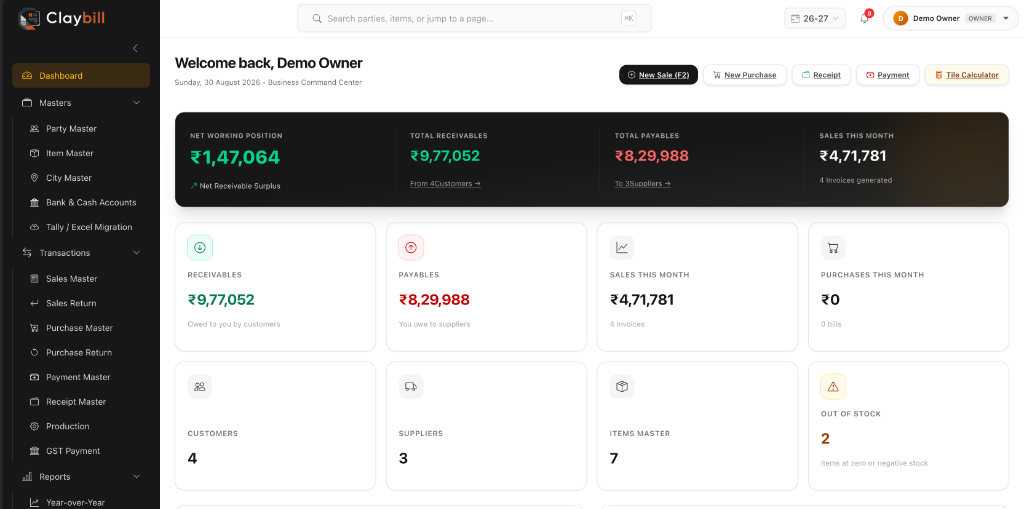
Most of the software we build at Anha Labs LLP is for other people's businesses. ClayBill is the one time we built it for ourselves — because we kept running into the same wall on client after client project in the tile and ceramic trade, and eventually building the right tool ourselves was faster than continuing to work around the ones that existed.
- ClayBill exists because generic billing tools could not handle Size, Grade, HSN and box-to-area conversions properly.
- It combines GST invoicing, stock, production and ledgers in one system.
- Building our own product improved how we build software for clients.
- You can try it free at claybill.in.
The problem wasn't billing software — it was generic billing software
Tile and ceramic traders don't invoice like a typical retail or wholesale business. Every line item needs a Size and a Grade alongside the HSN code — fields that determine the actual price and tax treatment, not just descriptive metadata. Off-the-shelf GST billing tools treat these as afterthoughts, if they support them at all, which means traders end up bolting on spreadsheets next to whatever software they're paying for. We saw this pattern enough times to recognize it wasn't a one-off complaint — it was a structural gap in what existed.
What we actually needed to solve
- Size, Grade, and HSN Code as first-class fields on every invoice line — not custom fields wedged into a generic schema
- Correct GST handling across Local Sales (SGST + CGST), Inter-State Sales (IGST), and Nepal Export in one invoice flow, computed automatically rather than manually selected
- Stock that stays accurate across purchases, sales, returns, and production — tile businesses often manufacture as well as trade, and most billing software has no concept of production consuming raw material into finished stock
- A print layout that actually looks like a real tax invoice from the trade, not a generic template with a logo swapped in
"We weren't trying to build 'billing software, but nicer.' We were trying to build the specific tool a tile trader's invoice actually needs — which is a different design problem than most GST software solves for."
Building it taught us things a client project never would
Building ClayBill as our own product, not a client deliverable, changed how we approached it. There was no fixed scope document to satisfy — we could sit with the real workflow (purchase → production → sale → return → GST report) and design the data model around how tile trading actually happens, then keep refining it after "launch" instead of handing it off and moving to the next project. Company data is fully isolated per account, so multiple businesses can run on the same platform without ever seeing each other's records — a constraint we hold ourselves to the same way we would for any client's data.
Why this matters for how we build client software
Running our own SaaS product — with real users, real support requests, and a real reason to keep improving it years after "done" — is a different discipline than shipping a client project and moving on. It's made us sharper about the questions we ask before a client project starts: not just "what does this need to do on day one," but "what does this actually look like to operate for the next three years." That's the lens ClayBill runs through every day, and it's the same one we now bring to every client engagement.
See it in action
ClayBill is live and in use today. If you're in the tile or ceramic trade, you can explore the live demo or set up your company in a couple of minutes — no credit card required.
What ClayBill covers today
ClayBill brings the daily paperwork of a tile and ceramic trading office into one system: purchase and sales invoicing with Size, Grade and HSN, GST tax invoices, party and item masters, live stock across every movement, production tracking, and party ledgers with outstanding reports. It also supports e-way bill and e-invoice generation from the same screens. You can see the full list on the ClayBill overview.
How we approached the data model
The main decision was to treat Size, Grade and HSN as first-class fields on every invoice line, not free-text notes. That makes reporting, stock and GST handling consistent, because the system understands what it is recording. Company data is kept separate per account so several businesses can safely use the same platform.
What we would tell other founders
- Start from a real workflow you understand deeply, not from a feature list.
- Pick a niche where generic tools clearly fall short.
- Ship a useful first version and improve it with real users.
- Plan for compliance, such as GST, from the beginning rather than bolting it on.
If you are exploring a similar product, see our custom software development service or talk to us.
Frequently asked questions
Who is ClayBill for?
ClayBill is built for tile and ceramic trading businesses that need GST billing, stock and ledgers designed around how the trade works.
Can I try ClayBill?
Yes. You can sign up and set up your company at claybill.in with no credit card required.
Is ClayBill GST compliant?
ClayBill produces GST tax invoices with SGST, CGST and IGST and supports e-way bill and e-invoice generation. Always confirm current GST rules on the official portal.
Does Anha Labs build similar products for clients?
Yes. We build custom software and SaaS products for clients, and our experience running ClayBill shapes how we do it.
Curious how we approach a product build?
Whether it's your own product idea or a client platform, we bring the same discipline: understand the real workflow first, design the data model around it, and build something meant to be operated for years — not just shipped once.